

Anyone can generate words now. Clear thinking is the scarce skill.
About the series. The 21st Century Communicator: Currency, Code and Craft is a Constellar series by Astrum on what it takes to stay relevant and be valued as communications is reshaped by disruption and technology. Each article explores one of three capabilities: Currency, the impact you drive for the business; Code, how you carry yourself and operate; and Craft, the depth and counsel that set you apart. This piece is about Craft: the depth of thinking and clarity of execution that set you apart.
Writing is thinking
Paul Graham argues that writing goes beyond communication skills; it is how we develop, sharpen and ultimately arrive at ideas. Put an idea on the page and its weak points show at once. Keep it in your head, and it can stay comfortably vague. The page is where a thought is tested.
Business has learned the same lesson. Amazon replaced slide decks with six-page written narratives, read in silence at the start of meetings. The reasoning was simple: full sentences force an author to work through cause and effect, where bullet points let the gaps hide. The discipline of writing is the discipline of thinking.
The machine widens the gap
Across industry reports and conversations with clients and Public Relations leaders, two concerns consistently emerge. One is that writing proficiency remains a significant skill gap among younger professionals. The other is that everyone is a writer now, and it all reads the same. Both are true, and AI sharpens each. A model drafts in seconds, which tempts you to accept its text and move on. Outsource the writing, though, and you outsource the thinking, and the thinking was the job. In the SPRINT report by PRCAI, senior leaders flag a widening writing gap in emerging and mid-level talent, while the flood of generated text pulls work toward sameness. The communicator who can still think on the page grows rarer, and worth more.
What the craft asks
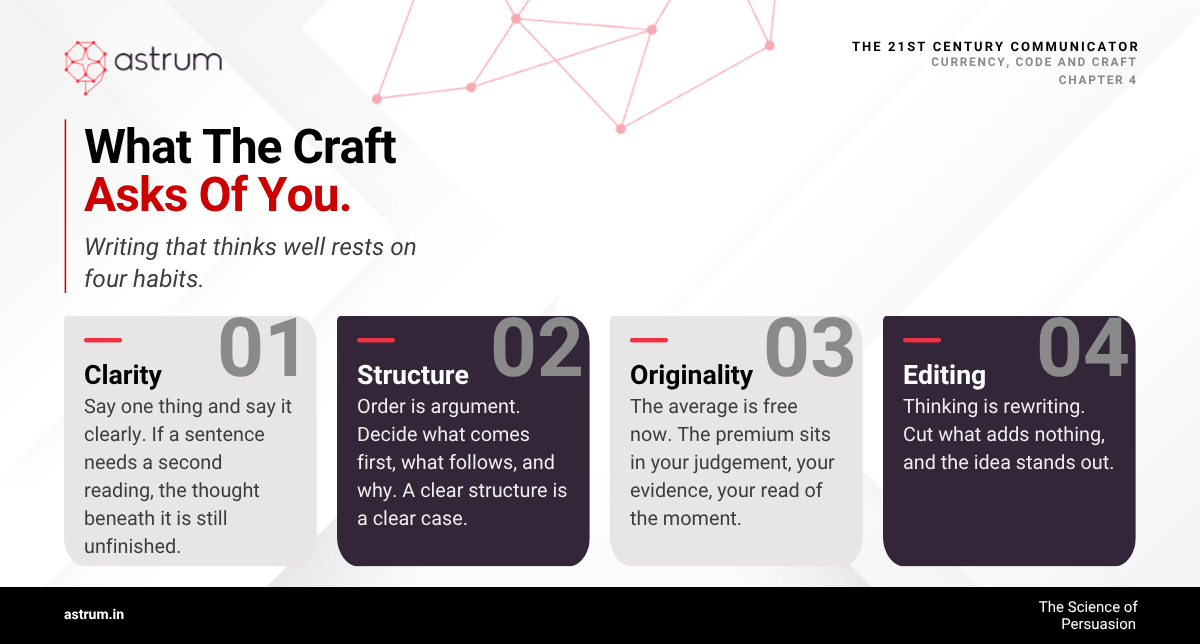
Writing that thinks well rests on four habits.
Clarity. Say one thing and say it clearly. If a sentence needs a second reading, the thought beneath it is still unfinished. Simple words on a complex idea are the mark of mastery.
Structure. Order is argument. Decide what comes first, what follows, and why, and the logic becomes visible to the reader and to you. A clear structure is a clear case.
Originality. Bring the point of view the machine lacks: your judgement, your evidence, your read of the moment. The average is free now, so the premium sits in what only you can say.
Editing. Thinking is rewriting. The first draft is you working out what you mean. The edit is where it turns clear and sharp. Cut what adds nothing, and the idea stands out.
Read to write well
Good writing starts long before the page, in the habit of reading. You write from what you have read. Wide and deep reading, across business, culture, history and the day’s news, is how a point of view forms and an opinion is earned. It builds range, reference and the judgement to know what matters. The machine can supply words on any subject. Only a well-read mind can tell which words are worth saying, and write with a voice the model has no way to copy.
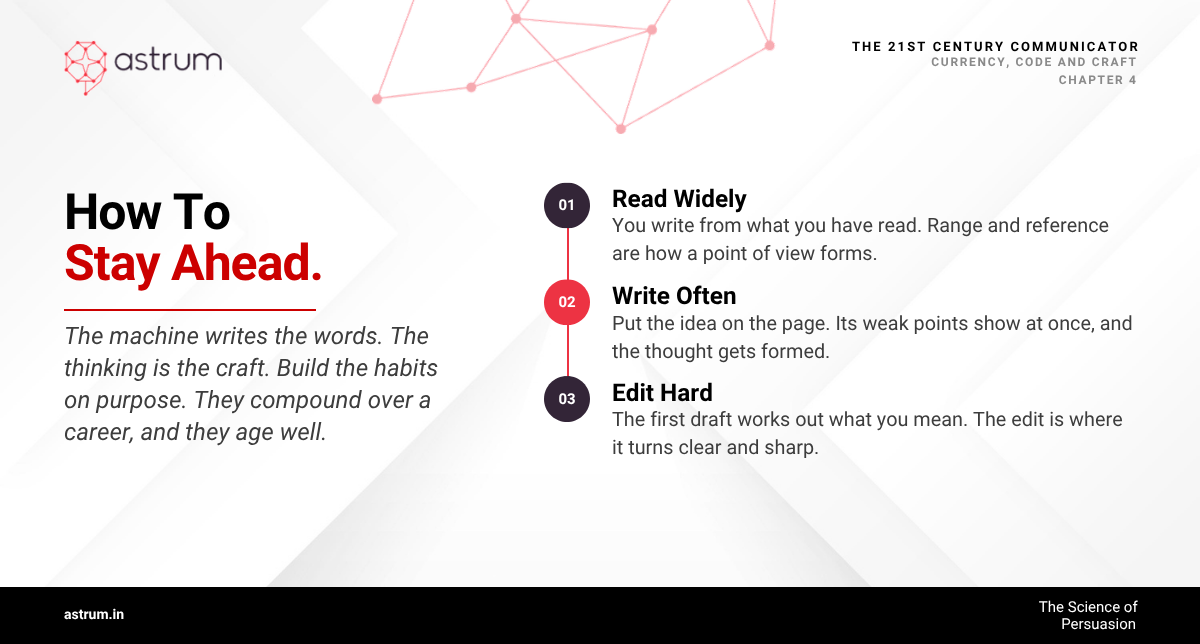
How to stay ahead
For the 21st century communicator, the implication is profound. As content turns cheap and uniform, the premium moves to a clear, original mind that can think on the page and hold a room. You stay ahead by building the habits on purpose: read widely, write often, edit hard, and use the machine as a sparring partner rather than a ghostwriter. They compound over a career, and they age well. The tools will keep changing. The professional who reads, thinks and writes keeps the counsellor’s chair.
The machine writes the words. The thinking is the craft.
Sources and accreditation
SPRINT, PRCAI. Study of Public Relations Insights, Nuggets and Trends, by PRCAI with Insights Partner Astrum, survey by Ipsos. Senior leaders report a writing gap in emerging and mid-level talent (about 75%), and concern that generative AI erodes originality (pp. 11, 43).
Amazon narrative memos. Widely reported, including CNBC (2018), that Amazon replaced PowerPoint with six-page written narratives, read at the start of meetings, to force clearer reasoning through full-sentence prose.
Paul Graham. Putting Ideas Into Words (2022), which argues that writing is a way to have ideas, and that testing an idea in prose reveals the gaps in one’s understanding.

Sharada is the Co-Founder and Chief Science Officer of Astrum and leads the evidence-based consulting practice, translating complex data into WinningKnowledge that empowers clients to strengthen reputation, pre-empt reputation risks, and build competitive advantage. She has nearly two decades of expertise in market research, public policy research, crisis preparedness and social impact, she has led high-impact studies for multinational corporations, domestic enterprises, and leading political parties.
An Economics (Honours) graduate with a master’s degree in Economics from the Delhi School of Economics, Sharada also holds executive certifications in Public Policy Analysis from the London School of Economics, UK, and in Transformational Leadership from XLRI Jamshedpur.