

About the series. The 21st Century Communicator: Currency, Code and Craft is a Constellar series by Astrum on what it takes to stay relevant and be valued as communications is reshaped by disruption and technology. Each article explores one of three capabilities: Currency, the impact you drive for the business; Code, how you carry yourself and operate; and Craft, the depth and counsel that set you apart. This piece is about Code: how you carry yourself and operate, and your command of the tools and the information environment of this age.
Communication has always moved with technology. The printing press, radio and television, the internet, social media and the smartphone each changed how content is created, distributed and consumed, and who holds influence. Through every wave, the communicator’s role has grown, from messenger, to strategist, to steward of reputation. Disruption is the constant, and working with it is the job.
AI is the newest wave, and it reshapes the whole value chain at once, changing how content is discovered, created, marketed and consumed. We read the scale of this early. In 2023 Astrum published “Technology Reshaping Communicators?”, built on four months of research and thought-leader interviews. When the machine reshapes the chain, it reshapes the work, the risks and the value. Command of the machine is how you meet it, and it is a way of thinking before it is a way of prompting.
The rules of the game have changed
Influence has been redrawn. Citizen journalists break news, the creator economy turned individuals into media brands, and trust has shifted from celebrity faces to niche voices. On social media, a brand can rise or fall overnight, and a single viral post can lift a reputation or sink it. News arrives in fragments, boundaries blur, and bots amplify and distort. As Astrum’s report puts it, technology is the gun, and we are the ones pulling the trigger.
When anything can be fabricated and everything can spread, trust rests on what can be verified and traced to a credible source. Verifiability and authenticity have moved from virtues to requirements. Gordon Stables of USC Annenberg argues that platforms must be held responsible for the authenticity of what they carry. The same duty sits with the communicator: show provenance, quote the source, and stand behind the work.
How does a 21st century communicator ride this wave?
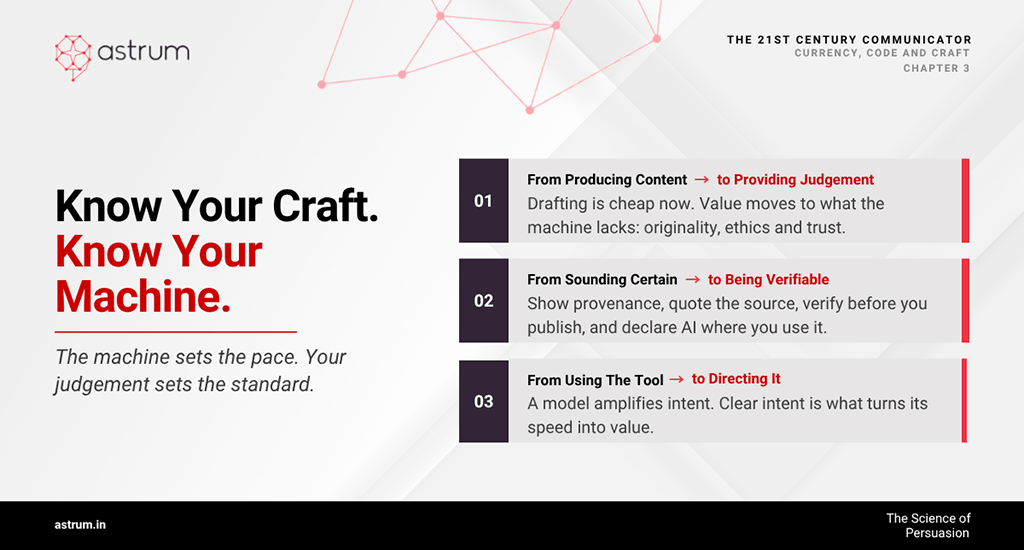
Jensen Huang, who runs Nvidia, puts the stakes clearly: you are not going to lose your job to an AI, you are going to lose it to someone who uses AI. Used well, the machine is a force multiplier. It drafts in minutes, researches at scale and clears the routine, so you move faster and sharper, and a small team does the work of a large one. The ones who ride the wave are the professionals who know their craft and know what they want from the machine. A model amplifies intent, and clear intent turns its speed into value.
The machine sounds certain whether it is right or wrong, and it returns the average of what it has seen. Klarna replaced the work of around 700 service agents with AI, then hired people again in 2025 when quality slipped and customers wanted a human. Give the machine the routine, and keep human judgement on the calls that carry risk. As the tool spreads and outputs converge, craft and judgement become the communicator’s edge, and the reason the role grows in worth.
The machine rewards those who know their craft, and know what they want from it.
How to ace the content value chain
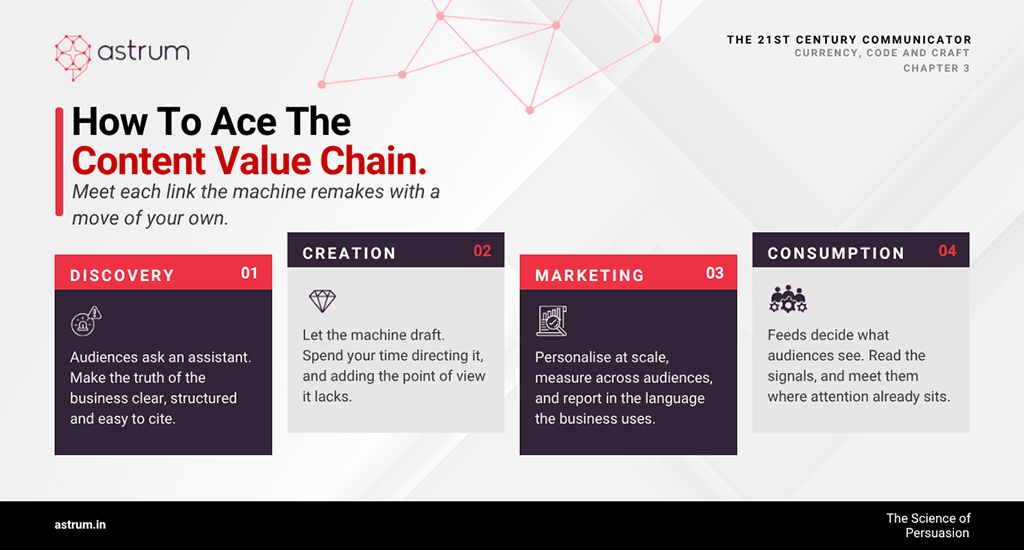
Meet each link the machine remakes with a move of your own.
Discovery. Audiences ask an AI assistant, and the answer is built from the sources a model trusts. Most content today is made for machines as much as for people. Make the truth of the business clear, structured and easy to cite, so the systems that mediate attention surface it. This is generative engine optimisation, the new search.
Creation. Drafting has collapsed in cost, and what once took days now takes minutes. Let the machine draft, and spend your time directing it, and adding the insight and point of view it lacks. Joe Lazer, author of The Storytelling Edge argues that as AI makes producing content easier, the communication skills that make writing distinctly human, perspective, judgement and storytelling, become more valuable.
Marketing. Distribution is predictive and personal. AI targets, recommends and tailors the message to the person. Use it to personalise at scale and measure across audiences, and report results in the language the business uses.
Consumption. Audiences pull content on demand, through feeds that decide what they see. Read the signals, and meet them where their attention already sits.
Know your craft, know your machine
Technology keeps changing. The human edge endures, and it now carries more weight. As the machine produces the average at scale, the onus on the communicator rises: for perspective and judgement, for authenticity, and for the fact-check. Inaccuracy is the leading risk in the research Astrum cites, deepfakes make sight a weak proof, and shared models pull everyone’s work toward sameness. Guard against each. Verify before you publish, declare AI where you use it, and test it against Astrum’s SIRI-T tenets of responsible use, integrity and transparency.
Value moves from producing content, which the machine now does cheaply, to supplying what it lacks: judgement, originality, ethics and trust. Nearly half of communicators have had no AI training at all, which makes this the opportunity of the decade for those who build the skill. In an environment this fast, the mindset that lasts is the lifelong learner’s: adaptive, agile and resilient. The tools will change, and the habit of learning is what keeps you ahead.
The machine sets the pace. Your judgement sets the standard.
Sources and accreditation
Astrum, 2023. Technology Reshaping Communicators?, an #AstrumInsights report, Astrum Management Advisory, October 2023. Four months of secondary research and thought-leader interviews. The quotes here from Joe Lazer and Gordon Stables, and the line that technology is the gun and we are pulling the trigger, are reproduced from this report, which also draws on WEF, McKinsey and Sandpiper for AI risk, use-case and training-gap data.
SPRINT 2026, PRCAI. Study of Public Relations Insights, Nuggets and Trends, by PRCAI with Insights Partner Astrum, survey by Ipsos. Records AI absorbing routine work and gaps in AI skills across the profession
Jensen Huang, Nvidia. Public remarks, 2025: you will lose your job to someone who uses AI, rather than to AI itself.
Klarna. Reported in May 2025 (Forbes, Entrepreneur) that Klarna resumed hiring human service agents after AI had replaced the work of around 700, following a decline in service quality.
Generative engine optimisation. GEO: Generative Engine Optimization, Aggarwal and colleagues, arXiv 2311.09735 (2023), published at ACM SIGKDD 2024.
This article was originally published on LinkedIn, read the complete piece on- https://www.linkedin.com/feed/update/urn:li:activity:7497980505745924098

Co-founder & Chief Science Officer
Sharada is the Co-Founder and Chief Science Officer of Astrum and leads the evidence-based consulting practice, translating complex data into WinningKnowledge that empowers clients to strengthen reputation, pre-empt reputation risks, and build competitive advantage. She has nearly two decades of expertise in market research, public policy research, crisis preparedness and social impact, she has led high-impact studies for multinational corporations, domestic enterprises, and leading political parties.
An Economics (Honours) graduate with a master’s degree in Economics from the Delhi School of Economics, Sharada also holds executive certifications in Public Policy Analysis from the London School of Economics, UK, and in Transformational Leadership from XLRI Jamshedpur.