


Communicators create influence. Measurement proves its value.
About the series. The 21st Century Communicator: Currency, Code and Craft is a Constellar series by Astrum on what it takes to stay relevant and be valued as communications is reshaped by disruption and technology. Each article explores one of three capabilities: Currency, the impact you drive for the business; Code, how you carry yourself and operate; and Craft, the depth and counsel that set you apart. This piece is about Currency: the value you create, measured in the impact you drive for the business.
The Public Relations profession wants to prove its worth, and mostly struggles to. In the SPRINT 2026 report by PRCAI, partnered by Astrum, almost all senior communicators want a common standard for measurement, while fewer than half fund one. Measurement is often treated as accounting, a cost to bear. Despite it being a strategic lever: what you can measure, you can move, and what you leave unmeasured, you leave to chance.
For the corporate communications professionals the implications are substantial. Reputation, trust and belief can be measured, and once measured, they can be shifted on purpose. A decade of Astrum’s research points the same way: strategic influence is achievable through a scientific process rooted in stakeholder insight, rather than through instinct and hope.
Movement over motion
Most reporting measures communication output, not its effect. Reach, impressions, coverage volume and advertising value equivalence tell us the scale of activity, but little about what changed because of it. The sharper question is movement: a stakeholder who changed position, an audience whose trust grew, a behaviour that shifted. The chain runs from what you do, to what people notice and believe, to how they act, and ultimately, to the value created for the business. This is the logic of the AMEC Integrated Evaluation Framework, the profession’s standard for evaluation.
Read both ends of that chain. Lagging signals confirm impact after the fact: a reputation score, a sales result, a trust index that moved. Leading signals show up early: rising sentiment, a message that pulls through, a base of advocates that grows. Lagging measures prove your worth, and leading measures let you steer before the outcome lands. The 21st century communicator watches both.
Set the baseline before you start
You can show a shift only if you measured the starting point. Decide, before the work begins, what you want to move and how you will know it moved. The sampling and the analytics can sit with your research partners; your job is the essentials: whose belief or behaviour you intend to change, what you will measure, and what a meaningful shift looks like. Name those, set the objective, and every result reads against it. This is return on objective, the measure that carries weight in a boardroom.
Influence is a science
Persuasion can feel like an art, and the best of it is. Underneath, it follows patterns that can be studied. Societies and cultures shape how people behave, and individuals respond to stimuli in ways that repeat and can be anticipated. Belief forms, hardens and shifts through mechanisms that decades of social and behavioural science have mapped. Read the patterns, and influence turns from a guess into a design.
This is where Astrum’s science of persuasion has real play. It blends data science, neuroscience and social science to generate the insight strategic communication is built on. A Reputation Health Index™ baselines where the reputation sits today. Message testing, scored through a Net Persuasion Score™, shows which words move people. Stakeholder segmentation sorts an audience into advocates, swing groups, sceptics and adversaries, so effort goes where minds can change, and Net Advocacy Score ™ can tell you exactly how effective your advocacy program was in shifting perceptions.
Insight is an investment
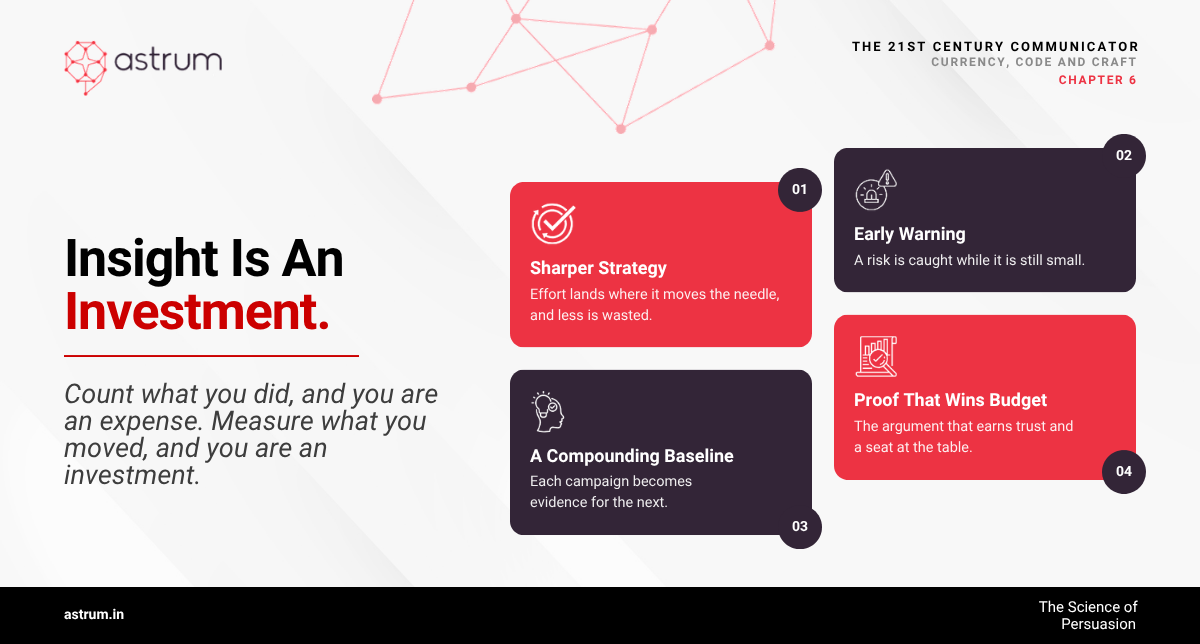
Data and insight are easy to dismiss as a passing fashion, or a nice-to-have for flush budgets. They are neither. They are an investment, and the return comes in several forms. Insight sharpens strategy, so effort lands where it moves the needle and less is wasted. It gives early warning, so a risk is caught while it is small. It builds a baseline and a benchmark that compound, turning each campaign into evidence for the next. And it arms you with proof, the one argument that wins budget, trust and a seat at the table. Measurement is what turns communication from a cost line into a case for investment.
What it means for the 21st century communicator
Tools now produce data in abundance, but data is raw material, and meaning is what you add. It takes human judgement to read a shift, to see why it happened, and to name what to do next. So leave the statistics to specialists, and be the one who defines what to move, commissions the science, and turns findings into a decision. The communicator who works from stakeholder insight, sets an objective and proves the shift becomes a strategic adviser, priced as one. The one who reports activity stays an executor. Expertise in the ‘Science of Persuasion’ is the premium of this Century.
Count what you did, and you are an expense. Measure what you moved, and you are an investment.
Sources and accreditation
PRINT, PRCAI. Study of Public Relations Insights, Nuggets and Trends, by PRCAI with Insights Partner Astrum, survey by Ipsos. 92% of corporate communicators want a common measurement standard, while only 46% allocate budget for one; emerging measures include return on objective (41%) and brand reputation/trust scores (50%) (p. 38).
AMEC Integrated Evaluation Framework. The International Association for the Measurement and Evaluation of Communication (amecorg.com/amecframework). Traces communication from objectives through inputs, activities, outputs, out-takes and outcomes to organisational impact, and rejects advertising value equivalence as a measure of value. Launched in 2016; AMEC is currently running a public consultation to update it as the framework marks its 10th anniversary in 2026.
Astrum research services. Astrum, Market Research and Insights (astrum.in). The Science of Persuasion approach, blending data science, behavioural science and neuroscience, includes the Reputation Health Index™, message testing via a Net Persuasion Score™, stakeholder segmentation into advocates, swing groups, sceptics and adversaries, and the Net Advocacy Score™.

Sharada is the Co-Founder and Chief Science Officer of Astrum and leads the evidence-based consulting practice, translating complex data into WinningKnowledge that empowers clients to strengthen reputation, pre-empt reputation risks, and build competitive advantage. She has nearly two decades of expertise in market research, public policy research, crisis preparedness and social impact, she has led high-impact studies for multinational corporations, domestic enterprises, and leading political parties.
An Economics (Honours) graduate with a master’s degree in Economics from the Delhi School of Economics, Sharada also holds executive certifications in Public Policy Analysis from the London School of Economics, UK, and in Transformational Leadership from XLRI Jamshedpur.