


ai summary
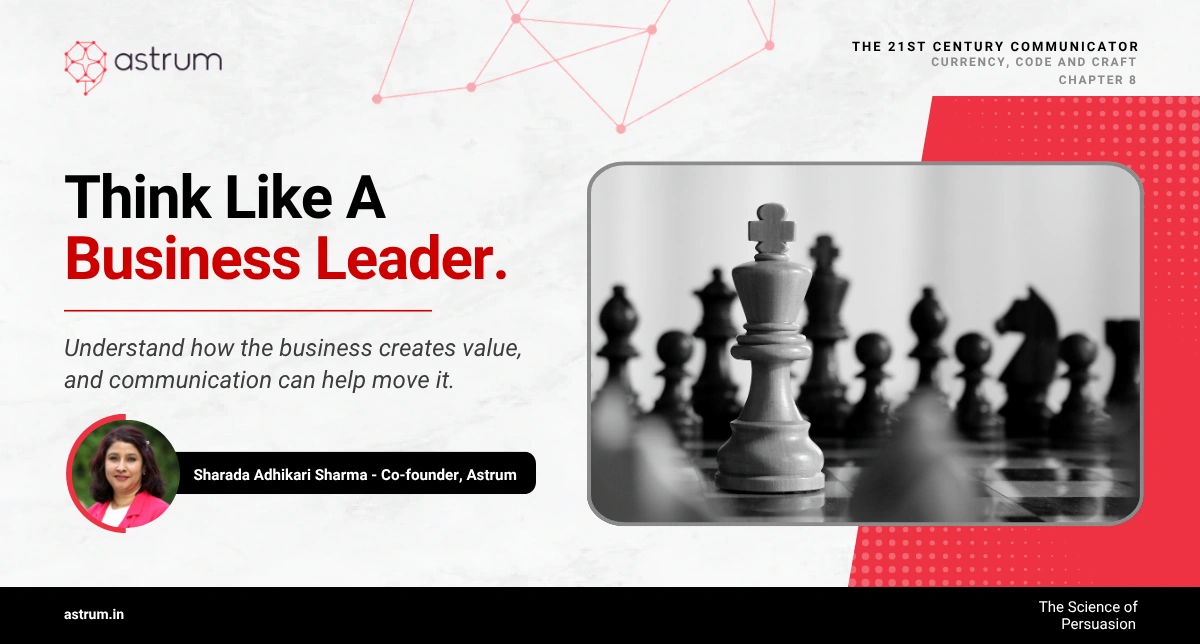
Understand how the business creates value, and communication can help move it.
About the series. The 21st Century Communicator: Currency, Code and Craft is a Constellar series by Astrum on what it takes to stay relevant and be valued as communications is reshaped by disruption and technology. Each article explores one of three capabilities: Currency, the impact you drive for the business; Code, how you carry yourself and operate; and Craft, the depth and counsel that set you apart. This piece is about Currency: the value you create, measured in the impact you drive for the business.
This series opened with a simple proposition: communications has moved from the sidelines to the centre, and its value lies in the business outcomes it helps create.
That shift brings a higher expectation. To create business value, you first have to understand how the business creates value.
Reputation influences choices made by customers, employees, investors, regulators and communities. Those choices can accelerate growth, create opportunity, strengthen resilience or increase risk. The communicator who understands these connections brings a different quality of thinking to the leadership table.
PRCAI’s SPRINT 2026 study, with Astrum as Insights Partner, reinforces the importance of business and domain knowledge to strategic contribution. The message for the profession is clear: to advise the business, learn to think like the business.
Who would you trust with what you value most?
Start with your own instinct. Picture your hardest problem, or the asset you value most. Who would you hand it to? Only one kind of person: the one who understands it the way you do, who is invested in its interest as deeply as you are, and who has the capability to steer it toward the outcome you want. Anything short of that, and you keep it close and handle it yourself.
A chief executive makes the same judgement about the business every day. Counsel is allowed near the things that matter only when the adviser clears those three tests: understanding, commitment and capability. To be that person for a business, you have to think as its owner would, in place of a supplier passing through. That is a higher bar than knowing the brand, and it is the bar this chapter is about.
Follow how value is created
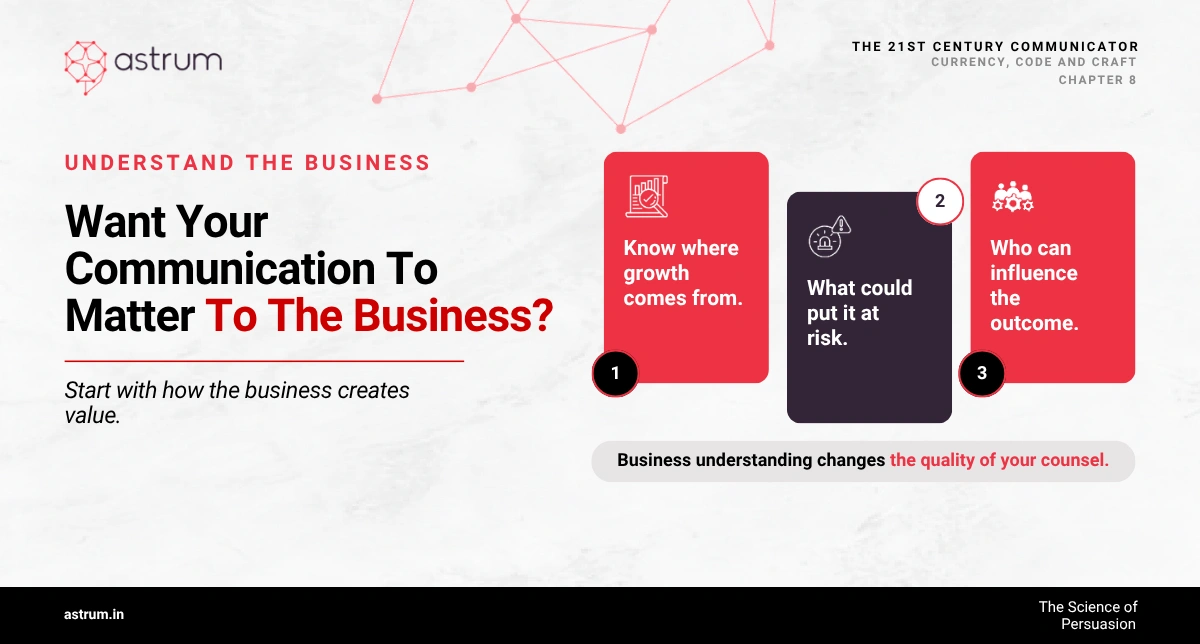
Learn how the company makes money. Understand where its next phase of growth will come from, what it competes on, which stakeholders can enable or constrain its ambition, and what could put that ambition at risk.
Then follow the connections.
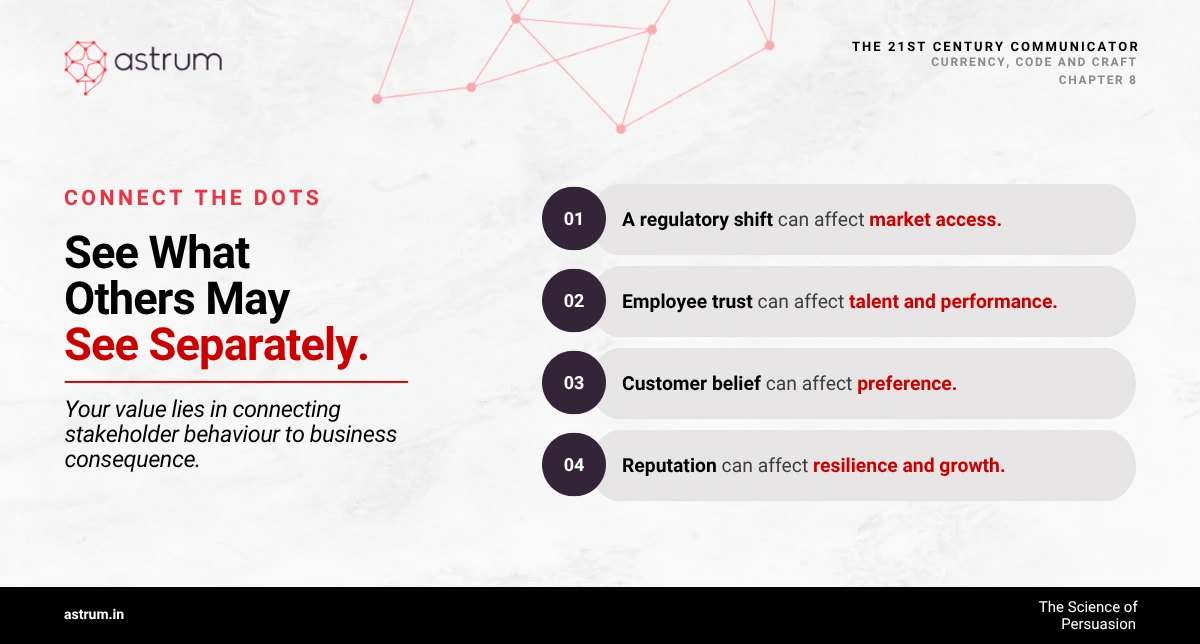
A regulatory change can alter market access or investment.
Employee sentiment can affect the ability to attract and retain critical talent.
Customer trust can influence preference, pricing power and resilience when something goes wrong.
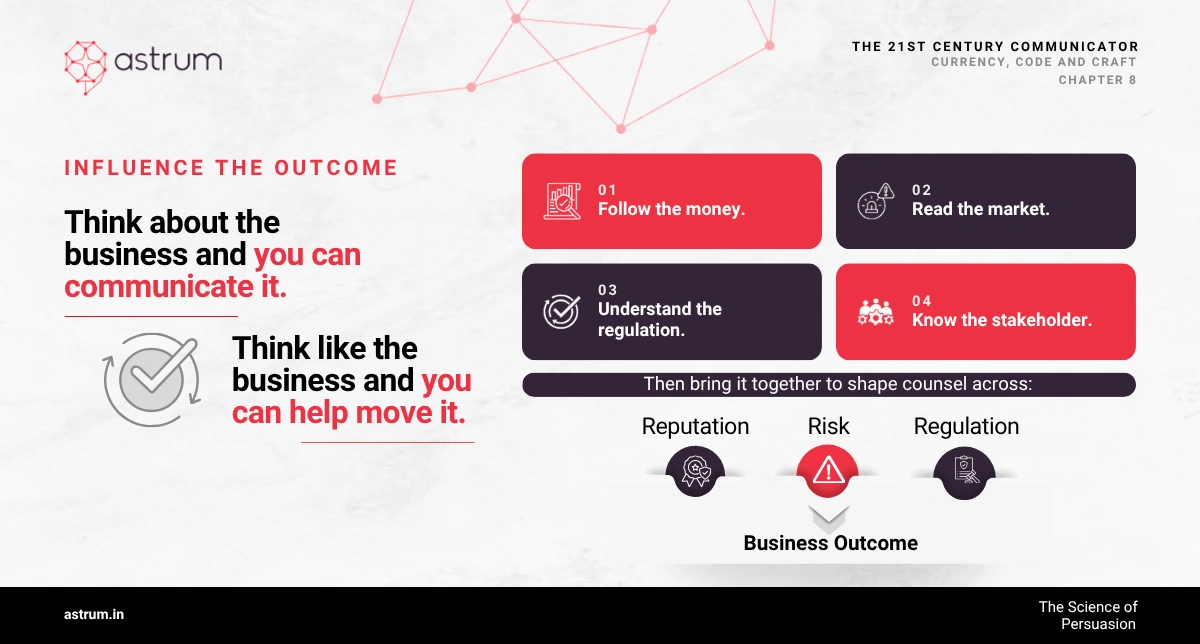
Reputation, Risk and Regulation increasingly intersect with business performance. The communicator’s value lies in understanding these connections and making them visible.
Go deep enough to contribute
Business fluency shows in the quality of your questions and the relevance of your counsel.
It matters when the numbers enter the conversation, when an apparently simple decision carries a commercial consequence, or when a crisis forces choices between competing interests.
Build enough depth to follow the argument, challenge an assumption and understand what a decision means for the enterprise and its stakeholders.
Your questions will begin to change too.
Move from What should we say? to What are we trying to achieve? What belief or behaviour is shaping the outcome? Who has the ability to influence it? What needs to change?
That is where communication begins to move from activity to impact.
Build your business fluency
Four disciplines can make it part of how you work.
Ask better questions. Stay curious about how the business works. Ask why a number moved, what leadership is prioritising, where growth will come from and what could derail it. The quality of your questions signals the depth of your understanding.
Invest in depth. Read beyond the communication brief. Study the annual report, earnings calls, analyst commentary, regulatory developments, competitors and category. Spend time with finance, sales, operations, policy and people teams. Research is part of the work.
Connect business outcomes to stakeholders. This is where the communicator brings a distinctive perspective. Understand the business ambition, identify the stakeholders who can enable it, uncover the beliefs shaping their choices and determine what could move them. That is the bridge between communication and business impact.
Use technology to extend your intelligence. Use AI, analytics and research tools to explore sectors, compare competitors, identify patterns and test hypotheses. Apply judgement to validate the evidence, understand its context a
Learn to navigate trade-offs
Business decisions often sit between competing priorities: growth and margin, speed and control, short-term performance and long-term trust, transparency and confidentiality, opportunity and risk.
Communication decisions carry similar choices.
A move that generates attention may also increase regulatory scrutiny. A message welcomed by employees may raise questions for investors. A rapid response to a crisis may have consequences for long-term trust.
Thinking like a business leader means seeing these tensions early, understanding their consequences and helping leadership make an informed choice.
Strategic communication enables the business outcome while strengthening the stakeholder relationships and reputation that sustain it.
Measure what you help move
The final connection is measurement.
If Currency is the value communications creates for the business, measurement should follow the same logic. Begin with the business outcome. Identify the stakeholder whose behaviour can influence it. Understand the belief that needs to shift. Then measure whether it moved.
That takes you beyond counting what communication produced to demonstrating what communication changed.
It also changes the conversation with leadership. You begin to speak in terms the business already uses: preference, trust, talent, risk, licence to operate, market access, resilience and growth.
What it means for the 21st century communicator?
Put business thinking into your counsel.
The opportunity for communications is growing, and so is the expectation. Learn the craft and learn the business with equal seriousness. Follow the money, the market and the regulation. Understand how value is created and where it is vulnerable. Know the stakeholders who can move the outcome. Read the numbers. Ask better questions. Connect reputation to risk and opportunity. Measure the movement you create.
Then communication goes further than explaining what the organisation is doing. It helps leadership understand what stakeholders need to believe and do for the business to succeed, and what the business needs to do to earn that response.
That is where communication becomes a business advantage.
Think about the business and you can communicate it. Think like the business and you can help move it.
Sources and accreditation
SPRINT, PRCAI. Study of Public Relations Insights, Nuggets and Trends, by PRCAI with Insights Partner Astrum, survey by Ipsos. Most practitioners rate business and domain knowledge as essential (about 80%, p. 42), and a majority say weak business understanding limits strategic contribution (about 82%, p. 43).
Arthur W. Page Society. The global professional association of chief communications officers. Its 2016 report, The New CCO, set out a model for the modern chief communications officer; its 2017 follow-up, The CEO View: Communications at the Center of the Enterprise, tested that model against CEO perceptions and documented the communicator’s expansion into enterprise leadership.
21st Century Communicators Series. By Sharada Adhikari Sharma, Cofounder, Astrum, Chapter 1, Reputation Is An Asset; Chapter 2, You Are Paid For What You Impact; Chapter 5, Measure What You Move

Sharada is the Co-Founder and Chief Science Officer of Astrum and leads the evidence-based consulting practice, translating complex data into WinningKnowledge that empowers clients to strengthen reputation, pre-empt reputation risks, and build competitive advantage. She has nearly two decades of expertise in market research, public policy research, crisis preparedness and social impact, she has led high-impact studies for multinational corporations, domestic enterprises, and leading political parties.
An Economics (Honours) graduate with a master’s degree in Economics from the Delhi School of Economics, Sharada also holds executive certifications in Public Policy Analysis from the London School of Economics, UK, and in Transformational Leadership from XLRI Jamshedpur.