


ai summary
The article argues that while talent earns opportunities, character earns lasting trust. Professional reputation is built through everyday choices, especially when no one is watching or when pressure is high. It stresses honesty, transparency, authenticity, accountability, discretion, respect, continuous learning and perseverance. For communicators and leaders, these values are especially important because they shape organisational culture and credibility. Ultimately, skill earns the assignment; character earns the trust.
Execution opens the door. Judgement gives you a voice. Counsel builds trust.
About the series. The 21st Century Communicator: Currency, Code and Craft is a Constellar series by Astrum on what it takes to stay relevant and be valued as communications is reshaped by disruption and technology. Each article explores one of three capabilities: Currency, the impact you drive for the business; Code, how you carry yourself and operate; and Craft, the depth and counsel that set you apart. This piece is about Craft: the depth of thinking and counsel that set you apart.
A career in communications and public relations often begins with execution: the release drafted, the event run, the deck built, the campaign delivered. It builds the discipline, judgement and credibility on which the next stage of your career depends.
But doing the work well can only take you so far.
The shift is subtle but significant. You move from being asked Can you do this? to What do you think we should do? From receiving the brief to shaping it. From delivering communication to helping leaders make better decisions.
That is the journey from executor to trusted counsellor.
The profession clearly aspires to make it. PRCAI’s SPRINT 2026 report points to strategic thinking as a capability senior leaders value highly. Yet access to leadership counsel cannot be claimed with a title. It is built through the quality of your thinking, counsel and consistent delivery.
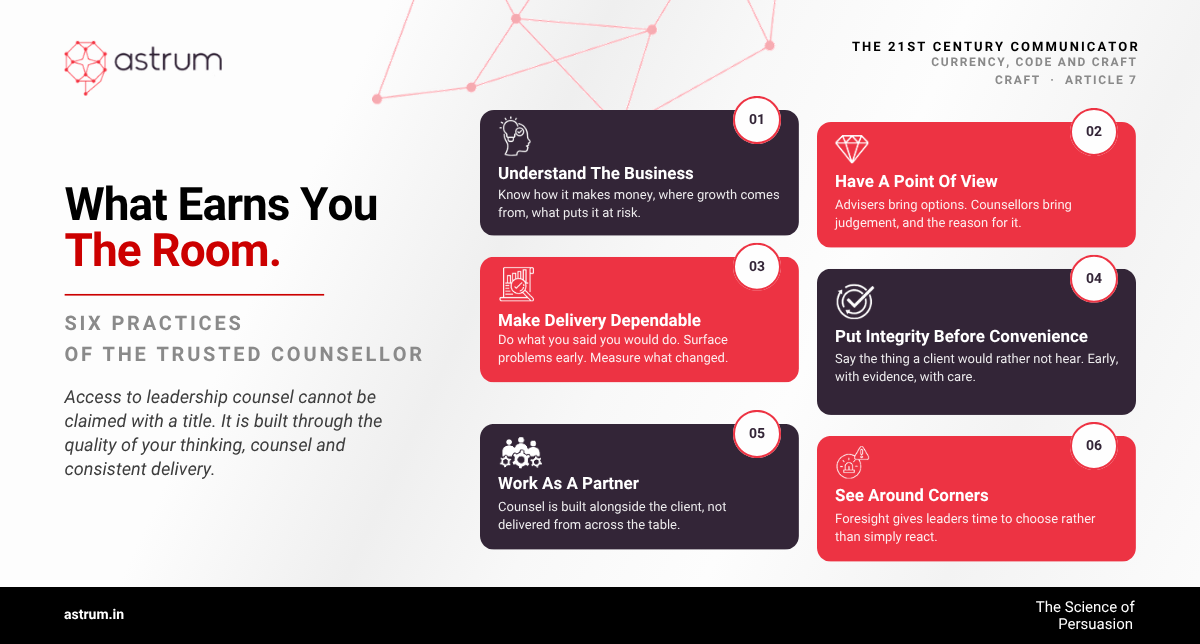
What earns you the room
Understand the business. Know how the organisation makes money, where growth will come from, what could put it at risk and what keeps its leaders awake. Communication counsel without business context remains communication advice. The value comes when you can connect reputation, stakeholder behaviour and communication choices to the outcome the business is trying to achieve.
Have a point of view. Good advisers bring options. Trusted counsellors also bring judgement. They can say, this is what I believe we should do, and this is why. A point of view does not mean certainty. It means weighing the evidence, understanding the trade-offs and being prepared to recommend a course of action.
Make delivery dependable. Counsel carries weight when it is backed by a record of delivery. Do what you said you would do. Surface problems early. Measure what changed. Show the result in clear terms. Reliability may not be the most visible part of counsel, but it is one of the foundations on which trust is built.
Put integrity before convenience. Sometimes the most valuable counsel is the advice a client would rather not hear. Say it early, say it with evidence and say it with care. Put the client’s long-term interest ahead of the easier answer, including when that answer would make your own life simpler.
Work as a partner. Trusted counsel is rarely delivered from across the table. It is built alongside the client: understanding the problem together, challenging assumptions and finding the answer that fits the situation. Frameworks can guide thinking. They cannot substitute for it.
See around corners. A counsellor pays attention to what has not happened yet: an emerging stakeholder concern, a change in regulation, a weakness in the narrative, a reputational risk gathering quietly or an opportunity others have not yet recognised. Foresight gives leaders time to choose rather than simply react.
Trust is the currency
None of this works without trust.
David Maister and his co-authors captured it neatly in The Trusted Advisor: trust grows through credibility, reliability and intimacy, and weakens as self-orientation rises.
The last part matters particularly in counsel. People know when you are protecting your position, selling the next assignment or trying to prove that you are the smartest person in the room. They also know when your attention is genuinely on the problem they need to solve.
That is when candour becomes possible. Leaders share what is uncertain, unfinished or uncomfortable. And that is often where the most valuable counsel begins.
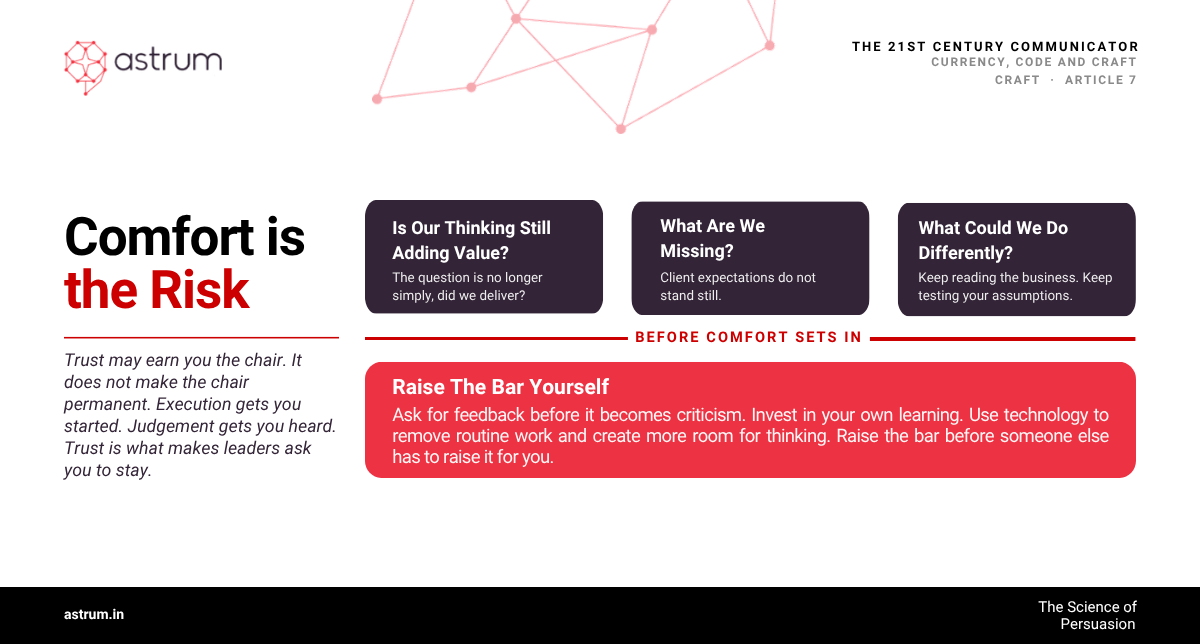
Comfort is the risk
Trust, once earned, brings its own danger: comfort.
The relationship is established. The work runs smoothly. You know the organisation and the people. What once demanded thought begins to feel familiar.
That is precisely when the counsellor has to become more demanding of their own work.
The question is no longer simply, Did we deliver? It is: Is our thinking still adding value? What are we missing? What could we do differently?
Client expectations do not stand still. Neither should your standard.
Keep reading the business. Keep testing your assumptions. Ask for feedback before it becomes criticism. Invest in your own learning. Use technology to remove routine work and create more room for thinking. Raise the bar before someone else has to raise it for you.
Trust may earn you the chair. It does not make the chair permanent.
What it means for the 21st century communicator
As technology takes on more of the routine work of communications, execution will remain necessary, but it will become less differentiating.
Your advantage as a communications professional will increasingly lie in what you bring to the work: context, curiosity, judgement, foresight and the courage to offer a considered and unbiased view.
So learn the client’s business as seriously as you learn the communications craft. Deliver consistently. Form a point of view. Tell the truth early. Stay curious when the work becomes familiar. And never confuse access with trust.
Execution gets you started. Judgement gets you heard. Trust is what makes leaders seek you for counsel.
Sources and accreditation
SPRINT 2026, PRCAI. 77% of corporate communicators identify strategic thinking as one of the top skills the industry requires (p. 4/5, Message from the President), while only 43% of corporate communicators agree that PR advisors are evolving into C-suite strategic partners (p. 33).
The Trusted Advisor. David Maister, Charles Green and Robert Galford (2000). Frames trust as an equation: trust rises with credibility, reliability and intimacy, and falls with self-orientation.

Sharada is the Co-Founder and Chief Science Officer of Astrum and leads the evidence-based consulting practice, translating complex data into WinningKnowledge that empowers clients to strengthen reputation, pre-empt reputation risks, and build competitive advantage. She has nearly two decades of expertise in market research, public policy research, crisis preparedness and social impact, she has led high-impact studies for multinational corporations, domestic enterprises, and leading political parties.
An Economics (Honours) graduate with a master’s degree in Economics from the Delhi School of Economics, Sharada also holds executive certifications in Public Policy Analysis from the London School of Economics, UK, and in Transformational Leadership from XLRI Jamshedpur.