

Talent gets you hired. Character decides whether you last.
About the series. The 21st Century Communicator: Currency, Code and Craft is a Constellar series by Astrum on what it takes to stay relevant and be valued as communications is reshaped by disruption and technology. Each article explores one of three capabilities: Currency, the impact you drive for the business; Code, how you carry yourself and operate; and Craft, the depth and counsel that set you apart. This piece is about Code: how you carry yourself and operate, and the character and values that earn trust.
Start with character. Every professional brings one to work, and the sum of those characters becomes the culture of a place. It shows in the small choices, the ones made when no one is watching, and those choices compound into who you are trusted to be.
This is Code, and it carries more weight than its quiet name suggests. Currency is the impact you make. Craft is how good you get. Neither holds up if Code fails you. A career stands on trust, and trust is character proven over time. Talent without it is a liability waiting to surface.
Character first, capability next
At Astrum, we hire for character first. Capabilities build over time, and skill can be taught and sharpened, but character is what a person brings into the firm on the first day, shaped long before any job. Hire for it at the entry, and you build capability on solid ground. The character each person carries becomes the organisational culture that follows.
Our code of conduct rests on a simple test: do the right thing when nobody is watching. Written rules cover the clear cases. The hard ones arrive in the grey, and there your conscience is the guide and your personal north star sets the direction in moments of confusion.
Character catches up
Compromise is rarely punished on the day. It is quiet at first, a shortcut here, a convenient silence there, and it compounds out of sight. Then it arrives all at once, and the higher you have climbed, the more the fall takes with it.
Character shows most under pressure. It is easy to do the right thing when everything is going right. The test comes when the stakes are high, when the honest call carries a real cost, and holding true to your character asks far more of you. Those high-stakes moments reveal character, and they set it.
The record holds many who reached the very top and lost it on character. Elizabeth Holmes built Theranos into a company valued in the billions and became its celebrated face, then was convicted of fraud in 2022, once the deception beneath it came apart. Lance Armstrong won the Tour de France seven times and inspired millions, then was stripped of every title and banned from the sport for life in 2012, once years of doping and denial caught up with him. Skill and fame took them to the summit. Character brought them down.
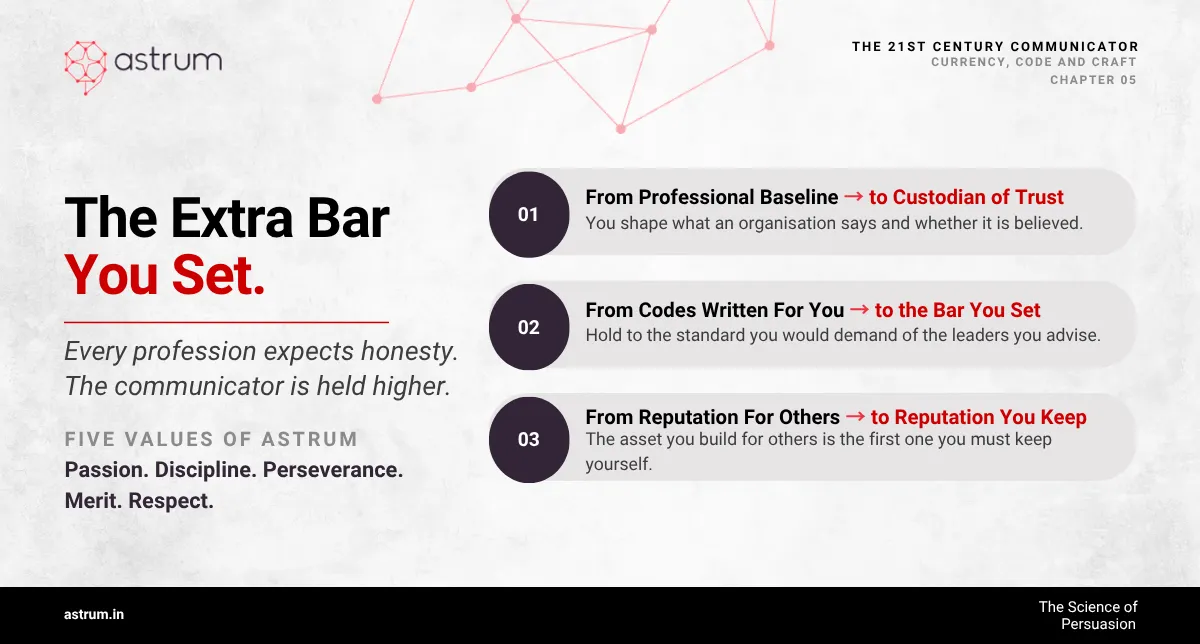
The extra bar you set
Every profession expects honesty, reliability and fairness. That baseline, set out in codes such as the PRSA Code of Ethics, is shared by all. The communicator is held higher, because you are the custodian of trust: of truth, of reputation, of the voice of the institution you speak for. You shape what an organisation says and whether it is believed, and in an age of synthetic content and instant scrutiny that charge only grows. In the SPRINT 2026 report by PRCAI, senior leaders now treat governance as mandatory.
Astrum names five values for this, passion, perseverance, discipline, merit and respect. They are the unwritten rules in short. The extra bar, though, is the one you set for yourself: to hold to the standard you would demand of the leaders you advise, before anyone asks it of you. Reputation is the asset you build for others, and the first you must keep for yourself.
The behavioural non-negotiables for the 21st century communicator
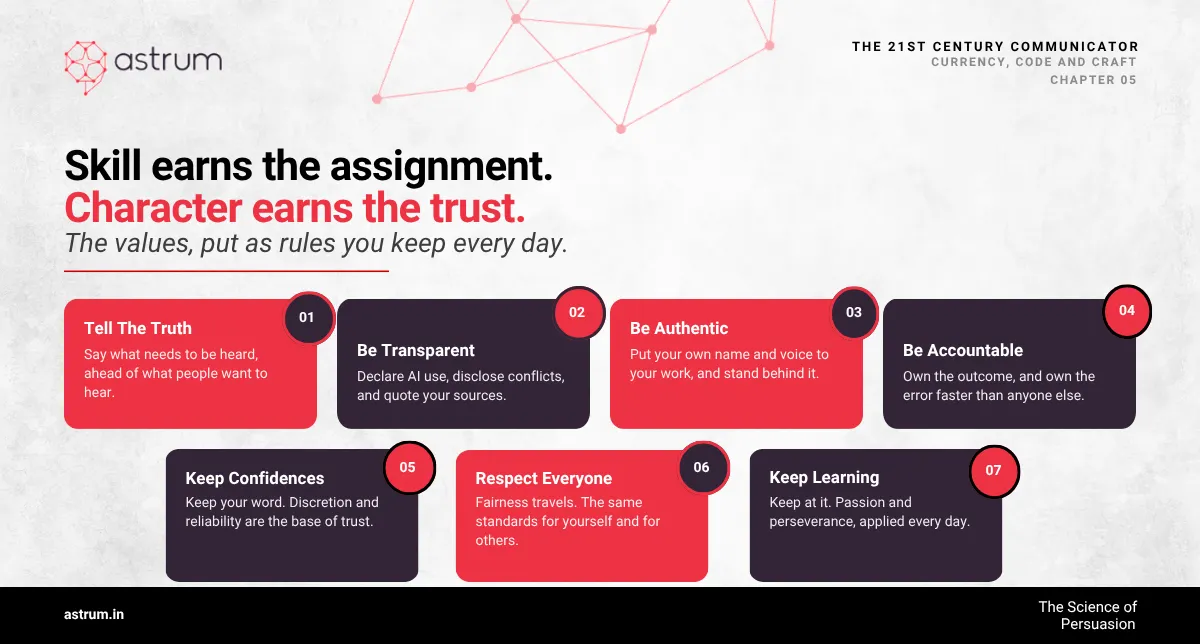
The values, put as rules you keep every day.
- Tell the truth. Say what needs to be heard, ahead of what people want to hear.
- Be transparent. Declare AI use, disclose conflicts, and quote your sources.
- Be authentic. Put your own name and voice to your work, and stand behind it.
- Be accountable. Own the outcome, and own the error faster than anyone else.
- Keep confidences, keep your word. Discretion and reliability are the base of trust.
- Respect everyone. Fairness to all travels. The same standards for yourself and for others.
- Keep learning, keep at it. Passion and perseverance, applied every day.
The standard is yours
Codes will be written and rewritten, and technology will keep testing them. Character is the constant, and it is the one part of a career that stays entirely in your hands, settled in the small moments more than the large ones. At the close of each day, when you look in the mirror, the question is simple: do you see a professional you are proud of. The honest answer, and the corrections it prompts, are the truest investment you make.
The same holds for organisations and leaders
The same holds for organisations and leaders, and it holds even stronger. A company has a character too, the sum of the choices its people make when nobody is watching, and a leader sets the tone the rest follow. In an age of instant scrutiny, values-led behaviour is read from evidence, and stated values earn belief only when conduct matches them.
So how do you evidence values-led behaviour? Show it in the decisions, in the trade-off taken when the right option costs more. Act early on the hard call, disclose where it matters, and let the record speak louder than the mission statement. This is where ethical leadership and a strong organisational culture become a reputation asset: character proven in behaviour, and visible to the people who decide whether to trust you.
Skill earns the assignment. Character earns the trust.
The machine writes the words. The thinking is the craft.
Sources and accreditation
Astrum values. Astrum’s five stated values: passion for the craft, perseverance, discipline of learning and application, merit, and respect for self, others and the profession.
Elizabeth Holmes, Theranos. Founder of Theranos, once valued in the billions; convicted of fraud in January 2022 and sentenced on November 18, 2022 to 11 years, 3 months in prison (US Department of Justice; NPR).
Lance Armstrong. Stripped of his seven Tour de France titles and banned from cycling for life in 2012 following a doping investigation; publicly admitted to doping in 2013 (UCI; USADA; BBC).
PRSA Code of Ethics. Public Relations Society of America. Six professional values: advocacy, honesty, expertise, independence, loyalty and fairness. Current edition: Member Code of Ethics 2000.
SPRINT, PRCAI. Study of Public Relations Insights, Nuggets and Trends, by PRCAI with Insights Partner Astrum, survey by Ipsos. Senior leaders treat AI governance as mandatory (about 85%) (p. 11).

Sharada is the Co-Founder and Chief Science Officer of Astrum and leads the evidence-based consulting practice, translating complex data into WinningKnowledge that empowers clients to strengthen reputation, pre-empt reputation risks, and build competitive advantage. She has nearly two decades of expertise in market research, public policy research, crisis preparedness and social impact, she has led high-impact studies for multinational corporations, domestic enterprises, and leading political parties.
An Economics (Honours) graduate with a master’s degree in Economics from the Delhi School of Economics, Sharada also holds executive certifications in Public Policy Analysis from the London School of Economics, UK, and in Transformational Leadership from XLRI Jamshedpur.