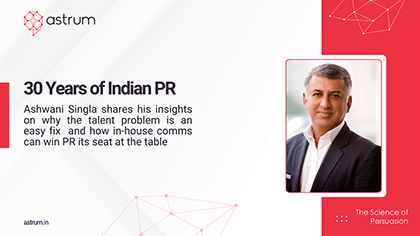


Why the brand that earns the right to tell its story will own the narrative in 2030 – Ashwani Singla, Founding Managing Partner, Astrum
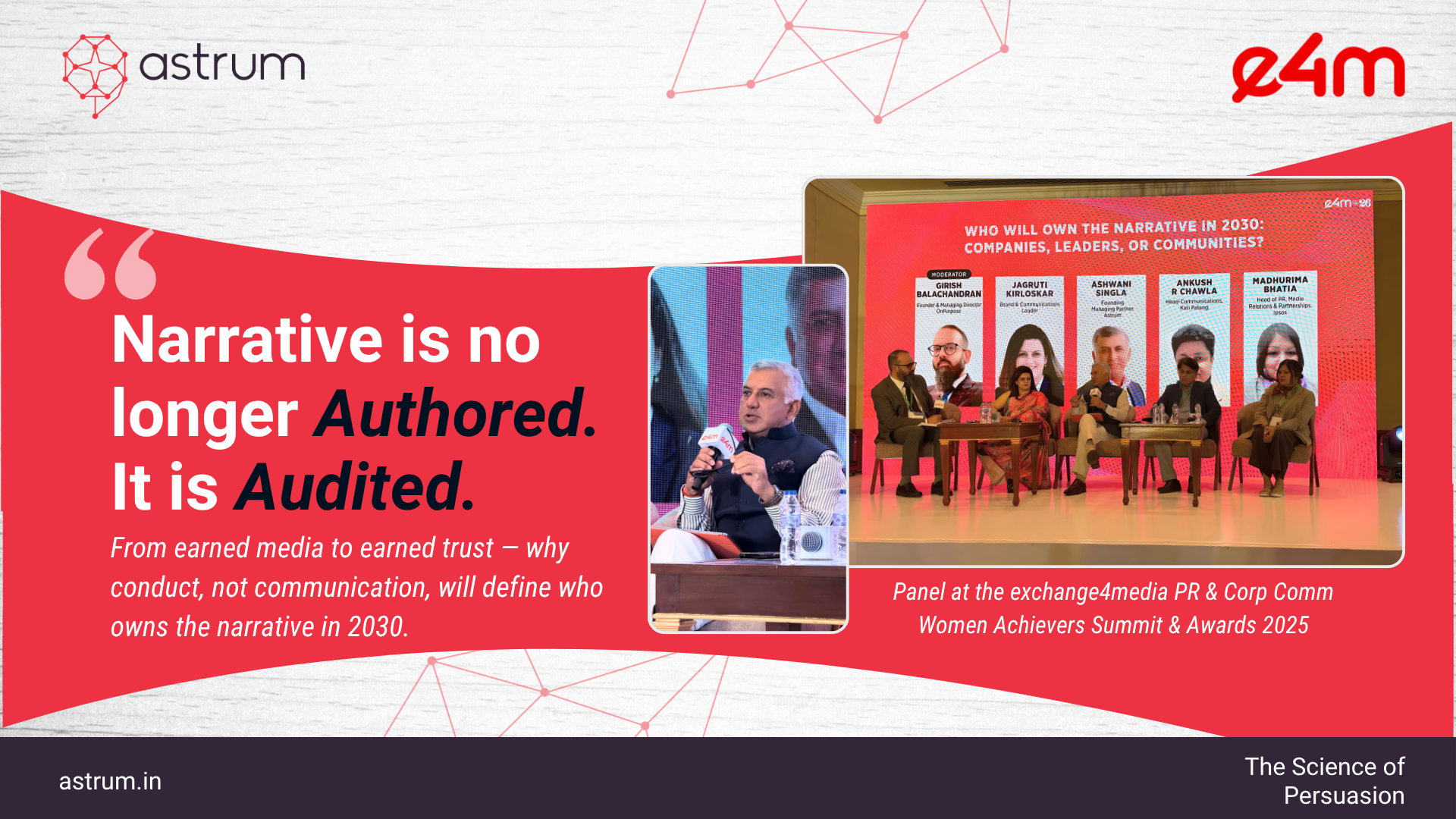
I recently had the opportunity to participate in a panel discussion organised by Exchange4media for a session that was interestingly titled Who will own the Narrative in 2030: Companies, Leaders, or Communities? Intrigued by the subject, that most people today call crystal grazing-crazy! Given you can’t even plan a year ahead!! Nonetheless, undeterred by the bold headline, I decided summate my point of view rooted in some simple truths that I have learnt in my three decades of consulting in Public Relations and Public Affairs.
Edward Bernays, who I consider to be the father of modern public relations, in the early 20th century, wrote in his book Crystalizing Public Opinion, the public relations counsel must “interpret the client to the public”. Almost a hundred years on, that principle has been quietly inverted. The public no longer waits to be interpreted. It interprets us, in real time, with a stored memory of every prior corporate action.
Who, then, will own the narrative in 2030? The question itself is perhaps misleading; it assumes someone still authors the story. The truth, in my three decades of practice, is simpler and more uncomfortable: narrative will belong to those who have earned the right through what they have done, not what they have decided to say.
Three Shifts Reshaping Corporate Reputation and Narrative Leadership
First, trust is pre-loaded. Audiences arrive at every issue with a verdict already half-formed. The 2025, a leading global firm’s research, recorded a thirty-four point gap in CEO trust between low-grievance and high-grievance audiences. The crisis does not create distrust; it merely reveals what was already true.
Second, communities are not replacing the leader, instead they are auditing the leader. Employee-shared content generates eight times the engagement of the official brand handle, and companies with high employee trust scores show 29% stronger consumer brand affinity. The workforce is now the most credible broadcast network a company has access to.
Third, earned media has been relegated to an input; “earned trust” is the outcome that matters. Media coverage is the receipt; trust is the balance in the account. You can print receipts all day; if the account is empty, no one cashes them.
Nonetheless, earned media still matters because credible third-party validation is what AI engines, regulators, investors, and policymakers treat as truth. But it now has to be served by, and sit on top of, earned trust. A story without trust travels; it does not convert.
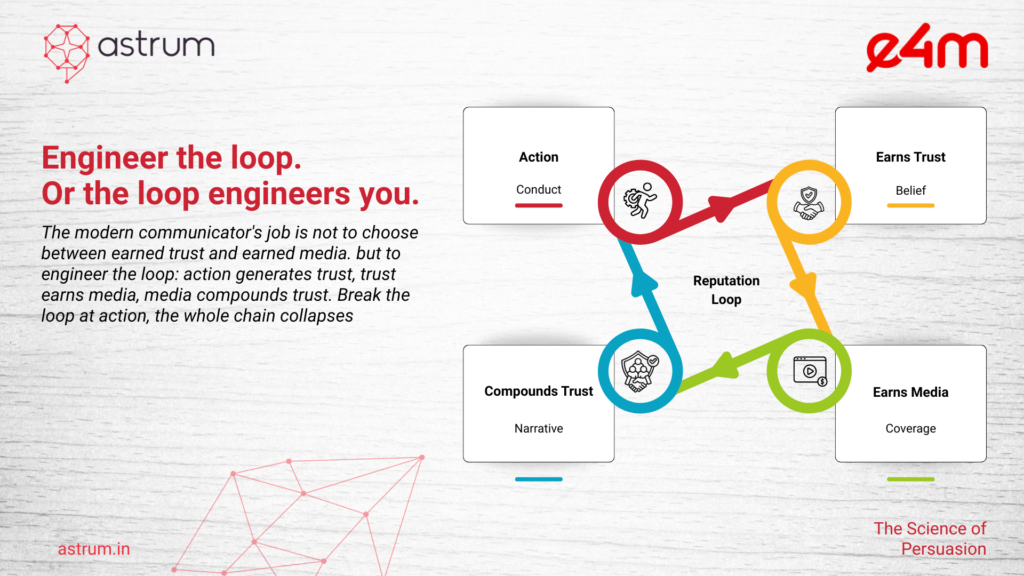
Earned trust without earned media is influence that hides. The job of the modern corporate communicator is not to choose between them, but to engineer the loop: action generates trust, trust earns media, media compounds trust. Break the loop at action, the whole chain collapses.
Measuring Corporate Reputation Beyond Share of Voice“
At Astrum, our position has been consistent: media engagement must chase views, not news; and authority, not publicity. The legacy KPI of share-of-voice flattered visibility whilst ignoring whether visibility moved belief. The new KPI is Net Advocates, the measurable gap between how stakeholders speak about you in public and how they would defend you in private.
This is why our Strategic Communications framework, #leadershipwithapurpose, endures: reputation rests on 4Cs, Capability, Character, Communication & Compliance; and it is Character, the match between word and deed, that distinguishes the leaders.
The corporate leader, then, is not dethroned by creators, employees or digital communities; the leader is upgraded from speaker to platform. The job now is to make the actions of the corporation observable, defensible and worth amplifying.
Evidence is available for all to see.
Byjus collapse from the most valuable Indian company to a footnote is why conduct matters!
In 2015 Maggie lost Rupees 450+cr in sales after the lead controversy. Recovery did not come from press coverage or sharper press releases. CMD Suresh Narayanan rebuilt trust block by block, with transparent engagement across stakeholders, then re-entered with the ‘We Miss You Maggi’ emotional reconnection. Market share returned to 60% by end of 2016.
The lesson: trust is re-earned in the same currency it was lost in, conduct.
At Astrum we say, Reputation must be earned, preserved and defended systematically with scientific precision. That is no longer a methodology, it is a survival framework. In an AI-mediated, community-curated world, leaders who treat reputation as the cumulative record of their actions, not the sum of their pronouncements, will always own the narrative today and in 2030!
Why? Because conduct is the only currency that does not depreciate.
Having argued for actions and authenticity, let me also summate my answers to two interesting questions pertinent to today as well.
First Question, what happens in a crisis? who controls the story first today: the PR team, the media, or the internet community?
None. The community renders a verdict in minutes; the media adds context in hours; the PR team can only frame what the prior behaviour of the brand allows. The story is decided before the crisis arrives.
The first three minutes of a crisis only reveal what years of behaviour have already written. Companies that try to ‘control the story’ in the moment have already lost. Companies that have earned credibility get the benefit of doubt that buys them time. Past action is the only crisis playbook that scales.
Second Question, Younger audiences connect more with creators, niche communities, and peer recommendations than with advertising. What does that mean for traditional corporate communications?
Frist some data points that I have gathered from a bunch of Gen Z & Millennials studies,
- 73% of Gen Z and 57% of Millennials rely on creators for purchase decisions. Creator content is now the default discovery layer for everything from consumer goods to financial services.
- 73% of Gen Z can identify a paid sponsorship even when not disclosed. Performance is detected; only authenticity earns engagement.
- 5.2x higher conversion is reported from recommendations inside micro-communities (Discord servers, private Instagram groups, sub-Reddits) than from traditional marketing channels.
So, is traditional Corporate communication obsolete. No. It has been re-scoped. Its job is no longer to broadcast a story, it is to supply the evidence that creators, employees, and communities use to tell the story for you. If you stop feeding the ecosystem with proof, the ecosystem writes the narrative from whatever data it can find. Therefore, what should you now be doing?
From script to source. Stop writing what others should say about you; start producing the evidence (data, decisions, behaviour) that they can independently cite.
From message to memory. Younger audiences carry memories. Inconsistencies between today’s campaign and last year’s behaviour are surfaced within hours.
In Summary
Narrative leadership in 2030 will not be assigned by title or platform. It will be earned by those whose decisions, deployed capital, hires, exits, public stances, and silences form a record that they would be willing to defend in a documentary made about them ten years from now. The CEO who runs the company that way owns the narrative. Everyone else borrows it.
As the character of Arnold Schwazneggar in a Netflix series says: That’s it and That’s all.

Founding Managing Partner
Ashwani is the Founding Managing Partner of Astrum. He has converted his passion for generating proprietary insights to inform strategy and messaging as the bedrock of his work. Considered amongst the most influential voices in the industry, he is a sought-after trusted advisor and strategist by both the C-Suite and Political leaders.
Before founding Astrum, Ashwani was the Asia MD of PSB Research and the CEO Co-Promoter of Genesis Burson-Marsteller (Burson). He is the Founder and Executive Director of Impact Research & Measurement, India’s media intelligence & measurement leader. He serves on the global executive board of IPRN, the largest independent PR agency network as well as the advisory boards of several companies and Not-for-Profits.