


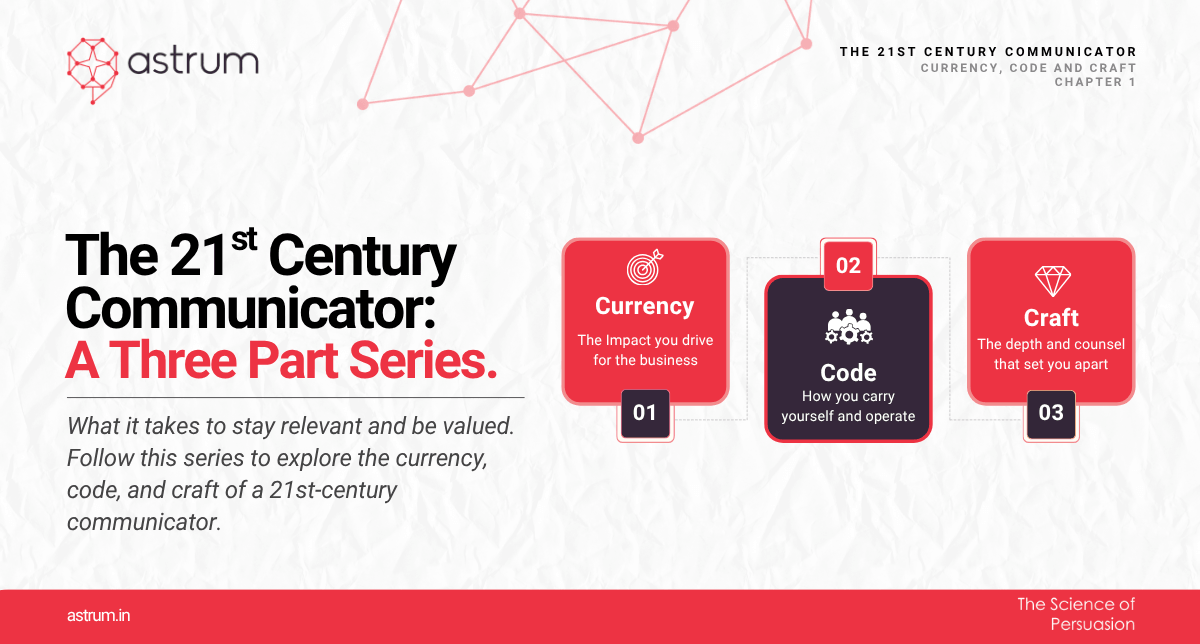
About the series. The 21st Century Communicator: Currency, Code and Craft is a Constellar series by Astrum on what it takes to stay relevant and be valued as communications is reshaped by disruption and technology. Each article explores one of three capabilities: Currency, the impact you drive for the business; Code, how you carry yourself and operate; and Craft, the depth and counsel that set you apart. This opening piece sets the premise the series builds on: as reputation becomes a hard asset, the communicator’s role rises with it.
Why this series, and why now.
The work of corporate communications is being reimagined. Artificial intelligence is changing how information is made, found and trusted. Scrutiny is constant, and it arrives in real time, from investors, regulators, employees and customers who weigh what a company says against what it does. ESG communications in India show the shift clearly, as investors and regulators weigh green and social claims against conduct. The old model of controlled messaging has loosened, and reputation now forms in the open, across many voices at once. The profession has moved closer to strategy and to leadership than it stood a decade ago, and the communicator is asked to be three things at once: a business mind who understands value, a fluent user of technology, and a maker of meaning who can hold an audience.
This series is a guide for 21st Century Communicators on how to stay relevant and be valued. It is built on three capabilities. Currency, the impact you drive for the business. Code, how you carry yourself and operate. Craft, the depth and counsel that set you apart. Together they describe what it takes to matter in the room and in the market. This opening article is the introduction. It sets the premise the rest of the series builds on: the one shift that explains why the role matters more today than it did before.
Reputation is a hard asset
Reputation has become the most valuable asset a company owns. In a market shaped by disruption, technology and rising scrutiny, it moves valuations, wins customers, and earns the benefit of the doubt at the moments that matter most. It is more than perception. It carries a balance-sheet consequence, and it decides whether investors hold or sell, whether customers stay or return, whether regulators lean toward patience, and whether the best people choose to join.
Research reported in SPRINT by PRCAI, partnered by Astrum, shows that most senior communicators already treat reputation as a driver of investor confidence and customer loyalty. On many balance sheets, intangible value now outweighs the physical, and reputation sits at its heart. The instinct is sound, and the economics behind it are real.
Reputation is earned, and it answers to behaviour
An asset of this kind sits beyond the reach of message management. You shape a reputation by shaping what the organisation does, then by making the proof of that conduct visible. Messaging can frame behaviour and sharpen it. Behaviour is what creates the reputation in the first place.
For the communicator, this redraws the job. The work moves upstream, from describing decisions to helping shape them, and from defending an image to building the evidence that earns it. Reputation management continues, but it now happens in behaviour, rather than in words.
Where the communicator creates value
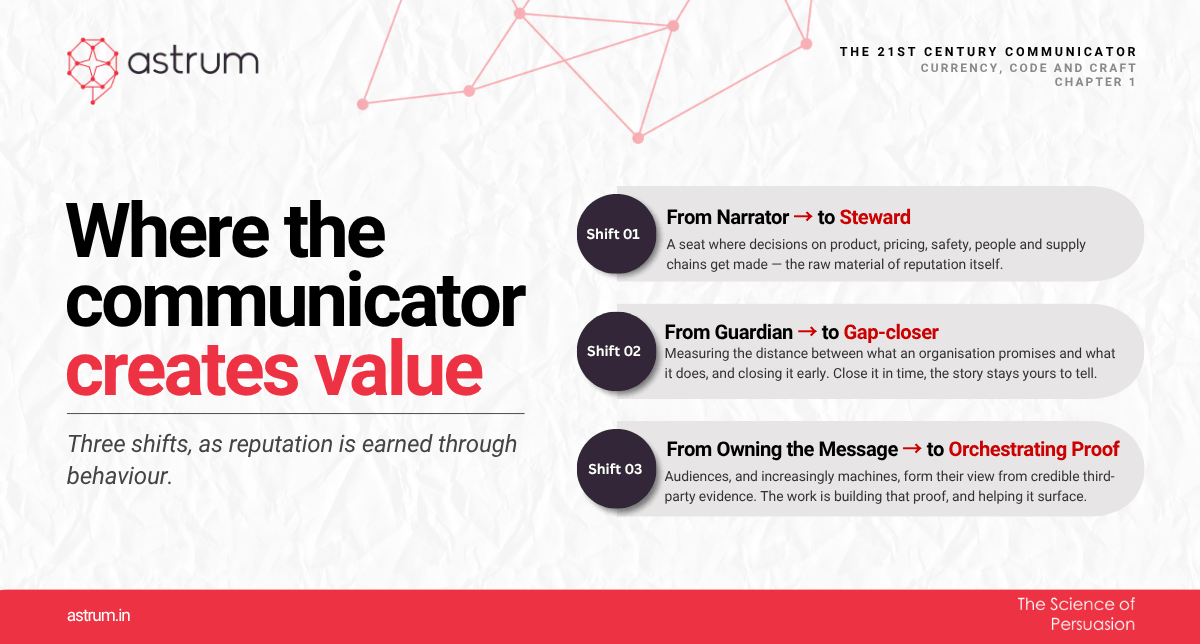
When reputation is earned through behaviour, the most valuable work moves upstream. It shows up in three shifts, and this is where the communicator, at any stage of a corporate communications practitioner’s career, becomes indispensable.
From narrator to steward. The storyteller’s craft endures. The greater value now comes from shaping the behaviour that becomes the story, which means a seat where decisions are made about product, pricing, safety, people and supply chains. Those decisions are the raw material of reputation.
From guardian to gap-closer. The instinct to protect the brand matures into something stronger: measuring the distance between what an organisation promises and what it does, and closing it early. Close the gap in time, and the story stays yours to tell.
From owning the message to orchestrating proof. Audiences, and increasingly machines, form their view of a company from credible third-party evidence. The opportunity is to build that proof and help it surface, so that strong performance is seen by the people and the systems that shape trust today.
The environment will keep shifting, and technology will keep raising the bar. Through all of it, one principle holds. The professionals who stay valued are those who help organisations earn reputation, and who can show the worth of what they build. That is the premise this series rests on, and it runs across three capabilities: the Currency of the impact you create, the Code of how you work, and the Craft that sets you apart.
An asset worth tending. A role worth mastering. That is the work of the 21st century communicator and the future of strategic communications.
Sources and accreditation
SPRINT, PRCAI – Study of Public Relations Insights, Nuggets and Trends, by PRCAI with Insights Partner Astrum, survey by Ipsos. Most respondents link reputation to investor confidence and customer loyalty, and further to stakeholder relations, crisis resilience and long-term revenue (pp. 20, 34).
Intangible asset value – Intangible assets now account for approximately 92% of the S&P 500’s market value, up from roughly 17% in 1975 (Ocean Tomo Intangible Asset Market Value Study, 2025).
This article was originally published on LinkedIn, read the complete piece on https://www.linkedin.com/pulse/reputation-asset-so-you-astrum-reputation-advisory-ekkff/

Co-founder & Chief Science Officer
Sharada is the Co-Founder and Chief Science Officer of Astrum and leads the evidence-based consulting practice, translating complex data into WinningKnowledge that empowers clients to strengthen reputation, pre-empt reputation risks, and build competitive advantage. She has nearly two decades of expertise in market research, public policy research, crisis preparedness and social impact, she has led high-impact studies for multinational corporations, domestic enterprises, and leading political parties.
An Economics (Honours) graduate with a master’s degree in Economics from the Delhi School of Economics, Sharada also holds executive certifications in Public Policy Analysis from the London School of Economics, UK, and in Transformational Leadership from XLRI Jamshedpur.