

Opportunities One Can Leverage to Build a Robust Corporate Reputation
In today’s complex and hyperconnected business environment, corporate reputation has become a strategic asset far beyond a communications outcome. Rapid technological change, rising stakeholder expectations, and heightened public scrutiny mean reputation can no longer be managed reactively. It must be built deliberately—through foresight, consistency, transparency, and strong governance.
Technology and human judgment, therefore, are increasingly seen working in tandem to define organisational performance and perception. At the same time, while the communications landscape has fundamentally altered, digital and social media can amplify issues at speed and scale, dismantling established brands within hours. This reality demands integrated, forward-looking reputation strategies that are aligned with the mechanics of digital communication and capable of sustaining organisational agility, resilience, and relevance over time.
Proactive Reputation-building Strategies
A strong corporate reputation is only built over years through consistent conduct, purposeful leadership, and disciplined execution. In an environment shaped by technological acceleration and evolving stakeholder expectations, reputation management cannot be episodic or defensive. It must be strategic, future-oriented, and embedded within governance structures and day-to-day operations.
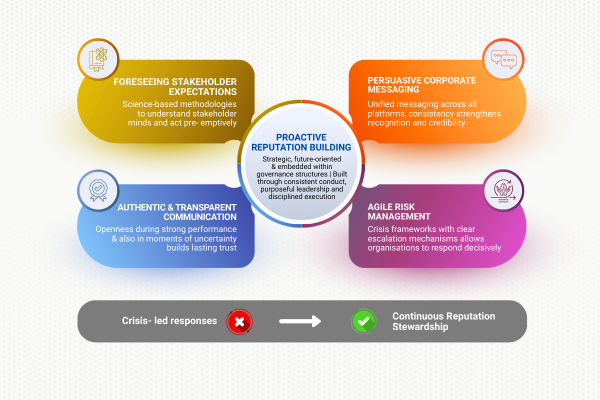
Reputation strategies, therefore, need to be adaptive and scalable, capable of addressing both foreseeable and emerging risks. Digital communication places even routine corporate actions under near real-time global scrutiny. For publicly listed companies and large conglomerates, this increases the likelihood that minor issues can escalate rapidly into material reputational challenges. Preserving credibility and trust requires a shift from crisis-led responses to continuous reputation stewardship.
Boards play a defining role in this transition and must ensure that reputation-building efforts are anchored in the following areas:
1. Foreseeing Stakeholder Expectations: Effective reputation management begins with a rigorous understanding of stakeholder expectations and the ability to anticipate reactions under stress. Using science based methodologies to understand stakeholder minds will enable boards and management to act pre-emptively, shape perception, and address vulnerabilities before they escalate. In India Astrum, a leading research-based strategic communications firm is pioneering this science based reputation management.
2. Persuasive Corporate Messaging: Reputation is reinforced through coherent and consistent corporate messaging. Organisations must communicate a unified narrative across all engagem ent platforms, including earned media, investor communications, marketing, digital channels, and direct stakeholder engagement. Consistency strengthens recognition and credibility, while fragmented or contradictory messaging weakens trust and organisational identity.
3. Authentic and Transparent Communication: Trust is sustained through consistent authenticity and transparency. Stakeholders expect openness not only in periods of strong performance but also during moments of uncertainty or transition, including leadership changes or strategic realignments. Clear, credible disclosures on long-term strategy, performance, governance, and sustainability signal accountability and reinforce confidence across investors, employees, customers, and communities.
4. Agile Risk Management: Geopolitical volatility, regulatory changes, and technological disruption can change public perception almost instantaneously. It is therefore one of the key responsibilities of the Board to ensure that agile risk and crisis frameworks are in place, with clear escalation mechanisms, empowered decision-making, and a culture that values timely, transparent communication. Such preparedness allows organisations to respond decisively while maintaining stakeholder confidence.
Role of Next-generation Technologies in Strategic Reputation Management
From an individual customer’s point of view, seamless digital experiences with an organisation—such as the ability to carry out a frictionless banking transaction—reinforce credibility and operational competence. At an enterprise level, next-generation technologies such as Artificial Intelligence (AI), machine learning, and advanced analytics enable real-time monitoring of stakeholder sentiment, public narratives, and emerging risks, underscoring the pivotal role of technology in shaping stakeholder perceptions and, consequently, corporate goodwill and value.
When deployed thoughtfully and supported by appropriate governance, these technologies enable faster, data-driven decision-making. They help leadership identify vulnerabilities early, contain potential issues before they escalate, and benchmark reputation performance against peers. Astrum’s DigitalOverwatch[1]™ (ADO) exemplifies this approach—an AI-driven digital intelligence platform that delivers real-time insights and predictive analytics to protect and preserve corporate reputation.
Importance of Environmental, Social, and Governance (ESG) in Reinforcing Corporate Reputation
Integrating Environmental, Social, and Governance (ESG) principles into business strategy has evolved from a compliance exercise into a cornerstone of corporate governance and long-term value creation. It reflects a company’s commitment to responsibility, transparency, and sustainable growth. How organisations deliver on ESG commitments—such as reducing environmental impact, fostering inclusion, and contributing to communities—directly builds stakeholder trust and reinforces corporate reputation.
In India, SEBI’s Listing Obligations and Disclosure Requirements (LODR) Regulations require the top 1,000 listed entities to publish Business Responsibility and Sustainability Reports (BRSR), aligned with the National Guidelines on Responsible Business Conduct[2] (NGRBC), embedding sustainability within boardroom deliberations.
Introduced in 2021[3], BRSR evolved from the earlier Business Responsibility Reporting framework into a structured, data-driven reporting model that balances compliance and ambition through mandatory Essential Indicators and voluntary Leadership Indicators.
SEBI’s ongoing refinements underscore a broader shift in governance—from oversight of financial performance alone to stewardship of sustainable value creation.
Boards play a decisive role in determining whether ESG remains a box-ticking exercise or becomes a driver of strategic advantage. By aligning sustainability priorities with business objectives, integrating ESG metrics into performance frameworks, and reinforcing accountability through transparent disclosures, they can strengthen investor confidence, organisational resilience, and long-term competitiveness in a highly dynamic business landscape.
In Conclusion
A robust corporate reputation is a strategic asset that demands continuous effort, leadership commitment, and foresight. Companies that lead by example set new benchmarks for their industries and shape broader societal expectations. Boards play a defining role in ensuring that these values are translated into tangible actions and measurable outcomes. Do you and your board do so?
The article was originally published in the latest issue of Board Stewardship. Here’s the link to the original article: Vol 3: Issue 11: February 2026 – boardstewardship.com

Chairman
Sunil Lulla is the Chairman of Astrum, India’s first research-based strategic communications consulting firm that helps clients successfully negotiate the complex landscape of Reputation, Risk, Regulation & ESG.
Sunil is known for his success in growing sustainable businesses, building enduring brands, and shaping organizational cultures. He brings deep insights into Indian consumers and in managing growth, business, and competitive strategy, mentoring the Promoter/ Next Generation/ CXO. Sunil continues to serve on Boards of listed companies and is very familiar with the governance principles and management of Boards.
For most of his storied career spanning close to four decades, Sunil has been in a leadership position, ensuring profitability, building marketplace success, and driving high employee engagement. These include MTV, SONY, The Times Television Network, Indya.com, HMV, Diageo, Balaji Telefilms, JWT, GREY group and BARC. He is the Chief Evangelist of The Linus Adventures, an advisory service focused on enabling businesses to compete, grow their brand and build their culture.
[1] https://archive.adgully.com/astrum-is-utilising-ai-for-real-time-sentiment-analysis-content-monitoring-ashwani-singla-142427.html
[2] https://www.saoicmai.in/E-LibraryBooks/NGRBC—9-Principles638833747086579794.pdf
[3] https://sustainability.icai.org/wp-content/uploads/2025/06/Background-Material-on-Sustainability-Business-Responsibility-Sustainability-Reporting-BRSR-Revised-Edition-2024.pdf